What muscles does an exercise bike work?
Mainly your quadriceps, and that is measured, not guessed. An intramuscular EMG study of cyclists, electrodes in the muscle rather than stuck on the skin, found the quadriceps fired with greater activation during the 1st quadrant of the pedal stroke[1], the push from the top of the circle, with the vastii working hardest, and the hamstrings coordinating with them through the rest of the revolution. Around those drivers, your glutes add power, your calves steady the ankle, and your core holds you on the saddle. What a bike does not meaningfully work is your upper body, and this guide is honest about that limit too, because knowing what muscles an exercise bike works is only useful if the answer is true.
Written by the Exercise Bike team. A bike is a lower-body machine and this page says so, rather than promising it sculpts everything. Updated 19 July 2026.
Contents
Key facts
- Muscle groups in the pedal stroke
- 5: quads, hamstrings, glutes, calves, core
- Quadriceps activation peaks
- 1st quarter of the stroke[1]
- Upper body worked
- None meaningfully
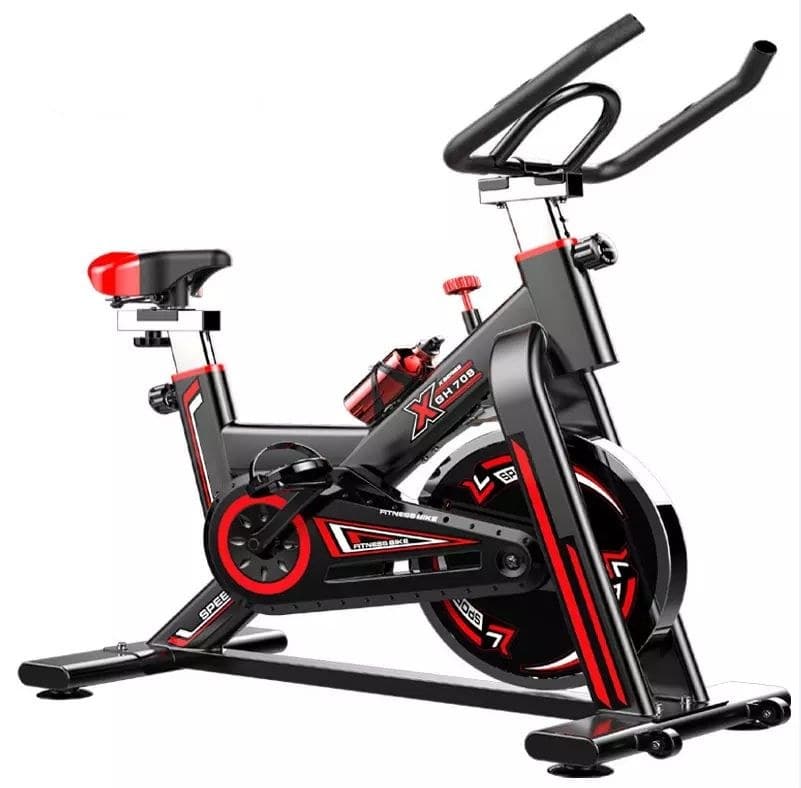
Studio Pro S3
Our spin bike, built for the standing, out-of-the-saddle efforts that bring the glutes fully into play.
See the Studio Pro S3Key takeaways
- 1Your quadriceps lead, firing hardest in the first quarter of the pedal stroke, with the hamstrings coordinating through the rest of the circle[1].
- 2Glutes add real power, but mainly under harder resistance or standing efforts, not gentle seated spinning.
- 3Your core stabilises your trunk on the saddle. It is posture work, not an ab workout.
- 4Steady riding strengthens and tones your legs. It is not a muscle-building programme on its own.
- 5An exercise bike does not meaningfully work your upper body. A rowing machine genuinely does more there.
The muscle map: what works, and when
Five muscle groups earn their place in a pedal stroke. One row per group, with the honest note on when each actually works.
| Muscle group | What it does on the bike | When it works hardest |
|---|---|---|
| Quadriceps (front of thigh) | The main drivers: they straighten your knee to push the pedal | The first quarter of the stroke, the push from the top[1] |
| Hamstrings (back of thigh) | Coordinate with the quads to carry the pedal through the circle[1] | Through the bottom and back of the revolution |
| Glutes | Add power from the hip; the gluteus medius steadies your pelvis | Harder resistance, and most of all standing efforts |
| Calves | Steady the ankle and finish each push through the pedal | Every revolution, quietly |
| Core | Stabilises you on the saddle; it is posture work, not an ab workout | Always on at a low level, more upright than reclined |
What muscles does an exercise bike work, exactly?
The quadriceps lead. The EMG study put its electrodes inside the muscles of nine cyclists, which is as direct as measurement gets, and found the vastii, the big outer and inner quadriceps, working hardest, with greater activation during the 1st quadrant[1] of the pedal stroke. The first quadrant is the first quarter of the circle: from the top of the stroke, pushing forward and down. The rectus femoris, the quad that also lifts the hip, joins them.
The hamstrings are not passengers. The same study recorded the biceps femoris, the outer hamstring, and described the complex coordination of quadriceps and hamstring muscles during cycling[1]: as one group pushes, the other guides, so the pedal moves in a smooth circle rather than a series of shoves. That coordination is why cycling feels fluid at any resistance, and why your thighs, front and back, are what ache after a hard session.
Does an exercise bike work your glutes?
Yes, with an honest caveat about how much. Your glutes extend the hip, so they contribute to every pedal stroke, and the gluteus medius works away steadying your pelvis on the saddle. But at easy, seated resistance the contribution is modest. The gluteus maximus, the big one, earns its keep when you push against real resistance or get out of the saddle, which is standing-interval territory: our spin bike, the Studio Pro S3, is built for exactly that kind of riding.
Does an exercise bike work your stomach or core?
As a stabiliser, yes. Your core holds your trunk steady while your legs drive, and it works harder the more upright and unsupported you sit. As an ab workout, no, and we are not going to pretend otherwise: pedalling will not give anyone a six-pack. If the real question behind this one is about a flatter stomach, that is a calories-over-time story, and our exercise bike and weight loss guide tells it without the nonsense.
Does an exercise bike build muscle or just burn fat?
It strengthens and tones your legs with steady use, and the firmer thighs and easier stairs are real. What it is not is a muscle-building programme. Building serious size needs progressive load that a cardio machine is not designed to provide, and a shop that implies its bike will sculpt you is selling you a picture, not a product.
What a bike does brilliantly is work those five muscle groups for half an hour without loading your joints, session after session. If you want that effort structured properly, our indoor bike workout ideas turn it into a week you can actually follow.
Which muscles does a recumbent bike work vs an upright?
The same movers drive both: quadriceps, hamstrings, calves. The differences sit around them. On a recumbent you recline against a backrest with the pedals out in front, so the backrest takes over much of the core's stabilising job, and standing efforts are off the menu, which keeps the glutes in their gentler supporting role. That trade is the whole point of the format, and how recumbent bikes work covers it properly.
On upright studio bikes you support your own trunk, so the core does more of its quiet work, and harder resistance brings the glutes further into play. Neither works a muscle the other cannot: the choice is about comfort and how hard you intend to ride, not about unlocking hidden muscle groups.
What an exercise bike does not work
Your upper body. Arms, shoulders, chest and back rest on the handlebars and go along for the ride. A bike is a lower-body machine, that is the honest limit of it, and no accessory changes it. If working your upper body in the same session matters to you, a rowing machine genuinely does more: we compared them properly in our exercise bike vs rowing machine guide, and it says plainly which reader should buy the rower.
Muscles and exercise bikes, questions answered
What muscles does an exercise bike work?
Does an exercise bike work your glutes?
Does an exercise bike work your stomach?
Does an exercise bike build muscle?
Do you work different muscles on a recumbent bike?
Does an exercise bike work your arms?
Sources
This page runs primarily on the EMG study above, which measured muscle activity with electrodes inside the muscle. The wider map, glutes, calves and core, is standard anatomy stated in plain terms, which is why those lines carry no citation and no percentages: we do not publish figures nobody has measured. This guide describes how muscles work during cycling. It is not training or medical advice.