Exercise bike vs rowing machine: which should you buy?
Start with the surprise: at a moderate pace these two burn the same. Harvard Health puts moderate cycling and moderate rowing at 252 calories each per 30 minutes[2]. So calories do not decide it. Muscle does. British Rowing says the rowing stroke works 85% of the muscles in your body across nine major muscle groups, including the back, shoulders, glutes, legs, arms and core[1], while an exercise bike is mainly a lower-body machine. If you want your upper body in the workout too, buy the rower. If you want the lowest-impact, simplest ride, less floor space and something kinder to your knees, buy the bike.
Written by the Exercise Bike team. We sell exercise bikes and no rowing machines, so we have said plainly where a rower is the better buy. Updated 18 July 2026.
Contents
Key facts
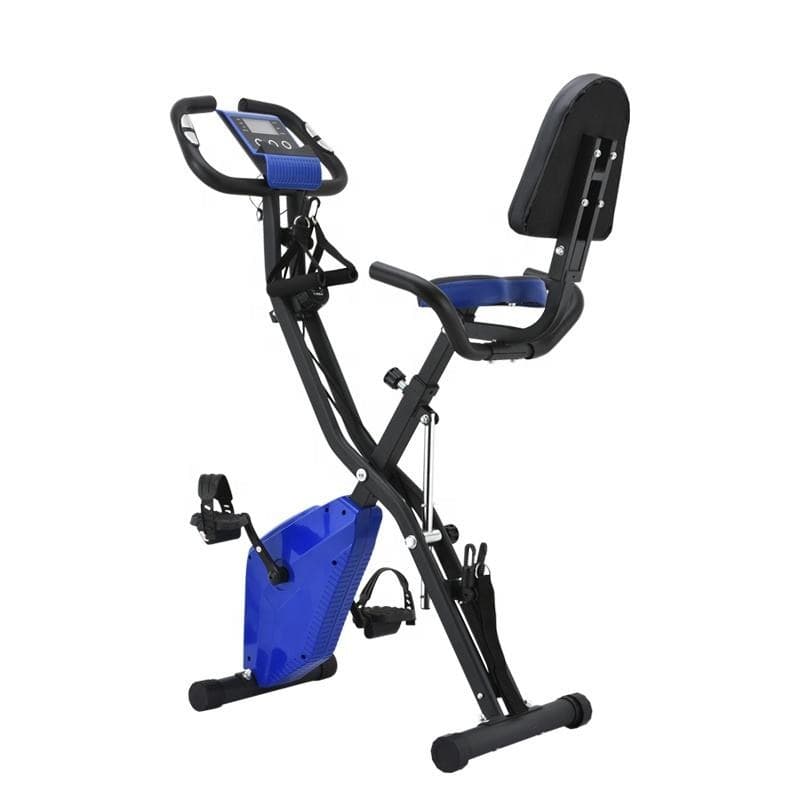
The FoldFit X1
Folds flat, £179.99 including VAT. A rowing machine needs its full length out; this disappears between rides.
See the FoldFit X1Key takeaways
- 1At a moderate pace, cycling and rowing burn exactly the same, 252 calories per 30 minutes[2]. Calories do not decide this one.
- 2Muscle does: rowing works 85% of your muscles across nine major groups[1], while a bike is mainly lower body.
- 3Buy the rower for a full-body workout, if you have the floor length for it.
- 4Buy the bike for the lowest impact, the smallest footprint, and the simplest way to just get on and pedal.
- 5A rowing machine needs well over two metres of floor. A folding bike needs roughly a chair's footprint.
Exercise bike vs rowing machine: the short comparison
The calories match, so the table below is really about everything else: which muscles you work, how hard it is on your joints, how much floor you need, and how simple it is to get going.
| What you are comparing | Exercise bike | Rowing machine |
|---|---|---|
| Calories in 30 minutes | 252 at a moderate pace[2] | 252 at a moderate pace, the same[2] |
| Muscles worked | Mainly lower body: legs and glutes | 85% of your muscles across nine groups, upper and lower[1] |
| Impact on your joints | Low, and you stay in one fixed seated position | Low too, but each stroke drives through the knees and back |
| Floor space | Roughly a chair's footprint, and some models fold flat | Its full length plus slide room, usually over two metres |
| Getting started | Sit down and pedal, no technique to learn | Worth learning the stroke to row well and safely |
| Price | £59.99 to £549.00 including VAT across our range | We do not sell rowing machines, so we do not quote a price for one |
Do a rowing machine and an exercise bike burn the same calories?
At a moderate pace, yes, and that is the honest headline of this whole comparison. Harvard Health lists both moderate stationary cycling and moderate rowing at 252 calories per 30 minutes for a 155-pound person[2]. They are not close, they are identical.
Plenty of pages will tell you a rower is the bigger calorie burner. At a matched, moderate effort the table does not agree. So if you are choosing purely to burn energy, this is a tie, and you should choose on something that is not a tie.
Does a rowing machine work more muscles than an exercise bike?
Yes, and this is where the two machines genuinely part ways. British Rowing, the sport's national governing body, says the rowing stroke works 85% of the muscles in your body across nine major muscle groups, including the back, shoulders, glutes, legs, arms and core[1]. That is a full-body movement: you push with your legs, swing through your back, and pull with your arms.
An exercise bike does not try to do that. It is mainly a lower-body machine, working your legs and glutes while your upper body mostly rides along. That is not a flaw, it is the trade. A bike keeps the movement simple and repeatable, which is exactly what some people want. If working your whole body in one session is the goal, the rower is built for it and the bike is not.
When you should buy the rowing machine, not the bike
Buy the rower if you want a full-body workout and you have the floor for it. We sell exercise bikes and no rowing machines, so this is the part of the page that sends you elsewhere, and it is the part we are most sure about.
- You want your upper body in the workout. British Rowing's nine muscle groups include the back, shoulders and arms, which a bike barely touches. For one machine that trains most of you at once, the rower is the buy.
- You want to build strength as well as cardio. The pushing and pulling of the stroke asks more of your muscles than steady pedalling does.
- You have the floor length. A rowing machine needs its full length plus room to slide, usually well over two metres, and many do not fold down small. If the space is there, that is no problem.
- You enjoy learning the movement. Rowing rewards good technique. If that appeals rather than puts you off, it is a point in the rower's favour.
If that sounds like you, buy the rower. We would rather point you at the right machine than talk you onto a bike that does half of what you actually want.
When the exercise bike is the right buy
The bike wins whenever the rower's full-body effort is not what you are after, or when its size, its learning curve or its demands on your joints get in the way.
- You want the lowest-impact, most stable ride. You sit in one position and pedal, with no stroke driving repeatedly through your knees and back.
- Space is tight. A bike takes roughly the footprint of a chair, and a folding model tucks into a cupboard. A rowing machine needs its full length out on the floor.
- You just want to get on and go. There is no technique to learn: sit down, set the resistance, pedal. That simplicity keeps a lot of people riding when a fiddlier machine would gather dust.
- You like to read, watch or take a call while you train. Sitting upright and steady makes that easy, which is harder mid-stroke on a rower.
Space is the sharpest example. Because a rower is long, the FoldFit X1, which folds flat at £179.99 including VAT makes the opposite promise: it disappears between rides. If you want to work harder on a bike, closer to a rower's intensity, a spin bike is the one to look at, and there are spin bikes built for exactly that. For steady everyday cardio, an upright exercise bike is the simplest place to start, or see our full exercise bike range.
Is 30 minutes on an exercise bike the same as 30 minutes of walking?
No. Harvard puts moderate cycling at 252 calories per 30 minutes against 175 for walking at 4 mph[2], so half an hour of pedalling burns more, and cycling is gentler on the knees than walking on pavement because your weight goes through the frame rather than through every footstep.
Which is better for weight loss, a bike or a rower?
Neither has a calorie advantage at a moderate pace, so it comes down to the machine you will keep using. Our guide on using an exercise bike for weight loss covers the calories and the timescales, and if you want a plan to follow, our indoor bike workout ideas set out what a week looks like. For sore joints, a bike is the gentler option, and our guide to low-impact bikes for sore joints explains what NICE and the NHS actually say.
Exercise bike vs rowing machine, questions answered
Do a rowing machine and an exercise bike burn the same calories?
Does a rowing machine work more muscles than an exercise bike?
Is a rowing machine or an exercise bike better for weight loss?
Is a rowing machine or an exercise bike better for bad knees?
Is 30 minutes on an exercise bike the same as 30 minutes of walking?
Do you need a lot of space for a rowing machine?
Sources
- British Rowing: Indoor rowing as cross-training for other sports
- Harvard Health Publishing: Calories burned in 30 minutes for people of three different weights (last updated 8 March 2021)
The calorie figures are for a 155-pound (about 70 kg) person over 30 minutes at a moderate pace. Heavier people burn more and lighter people burn less, so treat them as a comparison between the two machines rather than a target for your own session.