How to use an exercise bike, set up right from the first ride
Most of getting an exercise bike right happens before you pedal, and the biggest lever is the saddle. It matters more than it sounds: a review of 62 cycling studies found that overuse knee pain occurs in 50% of cyclists[2], and saddle height is the setting that shifts that risk most. Getting it right is not fussy, it is avoiding a coin flip. This guide covers the setup, how to turn the thing on, and how to read the resistance, with honest notes from building and riding all five bikes we sell.
Written by the Exercise Bike team. Our owner Asif built and rode all five bikes we sell. Updated 17 July 2026.
Contents
Key facts
- Target knee bend
- 25 to 30 degrees
- Overuse knee pain in cyclists studied
- 50%[2]
- Saddle height formula
- Inseam x 0.883
Upright bikes
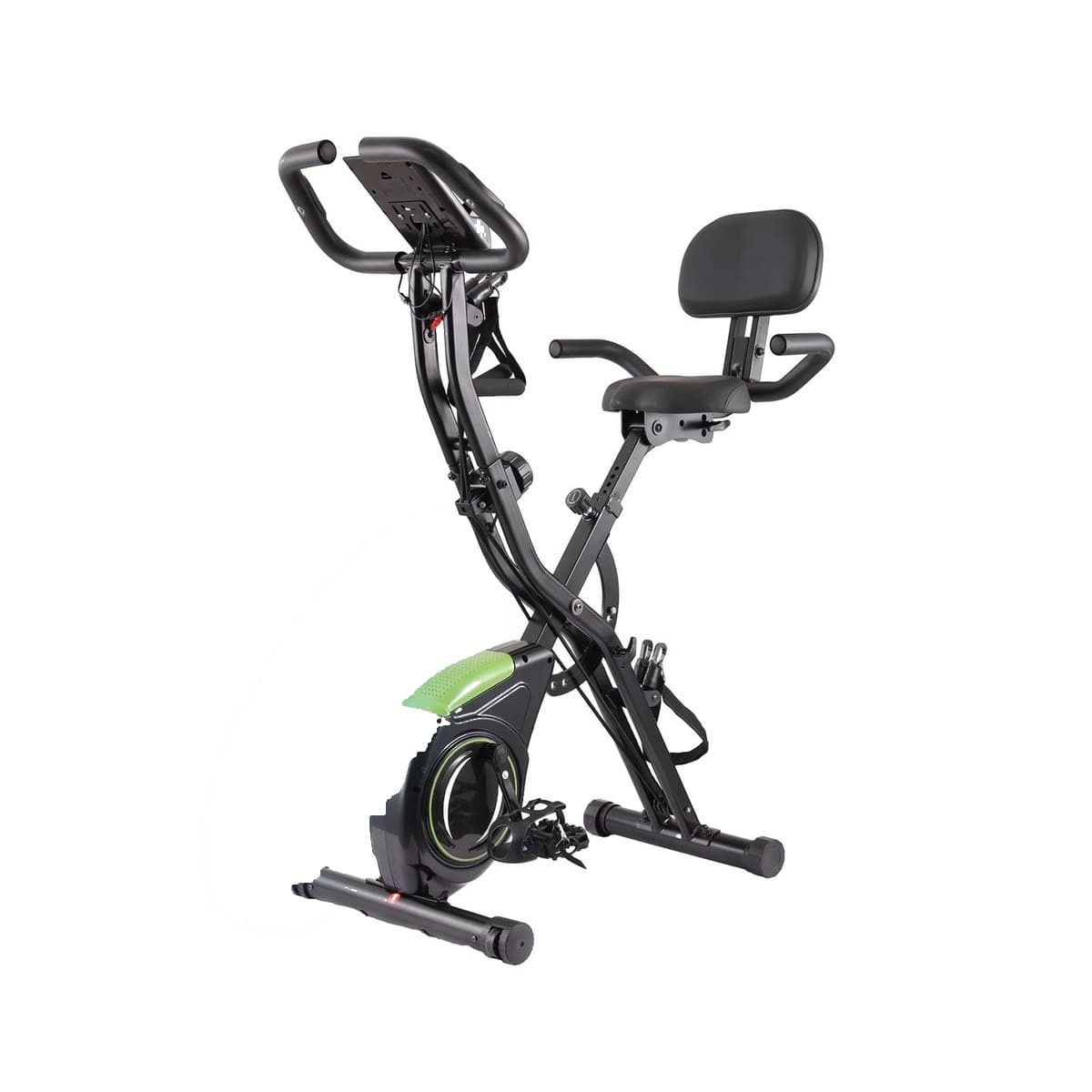
The CityRide U2 pictured above, and the format the heel method is written for.
See upright bikesKey takeaways
- 1Set the saddle with the heel method: heel on the pedal at the bottom with a straight leg, then the ball of your foot, which leaves a 25 to 30 degree bend at the knee.
- 2Overuse knee pain shows up in about 50% of cyclists studied[2], and saddle height is the setting that shifts that risk the most.
- 3Most magnetic exercise bikes have no power switch: the display wakes up when you start pedalling.
- 4Resistance numbers are not standardised between bikes. Judge your effort by your breathing, not the level shown.
- 5The heel method is for upright and spin bikes only. It does not transfer to a recumbent or a mini pedal exerciser.
How do you set the saddle height on an exercise bike?
This is the setting that matters most, and there is a thirty-second method for it that needs no tools. Cycling UK, the national cycling charity, teaches the heel method, and it works like this:
- 1Sit on the saddle and put your heel, not your toes, on the pedal.
- 2Turn the pedals until that foot is at the very bottom, the 6 o'clock position.
- 3Your leg should be completely straight. If your knee is still bent, the saddle is too low. If you cannot reach, it is too high.
- 4Now move your foot so the ball of it sits on the pedal. That leaves a slight bend at the knee, about 25 to 30 degrees, at the bottom of each stroke. That is the target.
The heel method, drawn: set the height with your heel and a straight leg, then ride with the ball of your foot and a slight bend. Our own diagram, not a photograph.
Here is why that number is worth trusting. It is not just one charity's rule of thumb: a review of 62 studies recommends setting saddle height with the knee flexion angle method, at 25 to 30 degrees, to reduce the risk of knee injuries[2]. One method is practical and one is clinical, they were worked out separately, and they land on the same range.
If you would rather measure than eyeball it, Cycling UK also gives a formula. Measure your inside leg barefoot against a wall with a book pulled up between your legs, then multiply that inseam by 0.883 to get the saddle height from the centre of the crank to the top of the saddle[1]. Their worked example: an inseam of 78cm gives 78 times 0.883, which is 68.87cm.
One important limit. This method is for upright and spin bikes, where the pedals sit below you. It does not transfer to a recumbent bike, where the pedals are out in front and the geometry is completely different, or to a mini pedal exerciser. If a recumbent is your bike, set it to a comfortable near-straight leg without overreaching, and follow the manufacturer's guidance rather than a road-bike rule.
Why does saddle height matter this much?
Because a small change does a lot. The same review found that a 5% change in saddle height shifted knee joint kinematics by 35%[2], and that the compressive force on the front of the knee goes up as the saddle goes down, so a saddle set too low quietly loads your kneecap on every stroke.
Two honest caveats, because we would rather you trusted the page than the headline. That review is from 2011 and it studied athletes on outdoor bicycles, not people on home exercise bikes. And the 25 to 30 degree figure is the authors' recommendation drawn from conflicting evidence, not a settled, proven number. It is the best-supported target going, and it is a target, not a law.
How do you turn an exercise bike on?
This is the question every beginner has and almost no guide answers. On most magnetic exercise bikes, there is nothing to turn on: the display wakes up when you start pedalling. When Asif built our CityRide U2, his own words were that he kept looking for a switch, then discovered it does not need one.
Some consoles run on a couple of batteries to power the screen and track your numbers, so if nothing lights up when you pedal, check the battery cover on the back of the display before you worry. That is a first-hand note from setting the bikes up ourselves, not a spec sheet.
How do you use a stationary bike as a beginner?
Get the saddle right first, then keep the first ride simple. Start at a resistance where you could still hold a conversation, ride for 15 to 20 minutes, and add a little time or effort each session. You are building a habit before you are building fitness, and a comfortable first ride is what gets you back on the bike.
One thing not to trust on day one is the resistance number, which brings us to the next question. And if fat loss is your goal, cycling helps by burning calories rather than by targeting any one area: our weight loss guide covers how that works. For structured sessions once you are settled, see our workouts and HIIT guide.
What do the resistance levels actually mean?
The number on the display is a dial, not a standard unit. There is no rule that level 10 on one bike matches level 10 on another, and our own range proves it. On the FoldFit X1, Asif found that up to level 10 he could not feel much, and at level 16 he nearly died. On the CityRide U2, even level 15, near the top, did not bring the pain he was bracing for.
Same mechanism, different execution, and no shared scale. So judge your effort by your breathing and your legs, not by the number, and use the display to repeat a session rather than to compare one bike to another.
How do you make the seat comfortable?
Start with the height, because most of what people call an uncomfortable seat is really a bad fit. Cycling UK lists the trouble a wrong saddle height causes: knee pain, saddle discomfort, a loss of pedalling power, hips rocking side to side, and numbness[1]. Get the height right and a lot of that goes away on its own.
Then check the fit the way Cycling UK does: your hips should not rock as you pedal, your knees should track in line with the pedals, and you should feel no strain, with no knee, hip or lower-back pain after a ride[1].
An honest note from our own riding: comfort also depends on you, not just the setup. At 107 kg, Asif would not sit on the FoldFit X1 or the CityRide U2 for more than about 15 minutes in one go, and he is clear that is his weight rather than a fault in the bikes. Shorter, more frequent rides are a fair answer to that.
And if the seat still fights you once the height is right, the fix is a padded seat cover, not a different bike.
We do not give medical advice. If you already have a knee problem, saddle height is about fit, not a medical fix. Our guide to using an exercise bike with bad knees sets out what NICE and the NHS say.
How to use an exercise bike, questions answered
How do you use a stationary bike for beginners?
How do you set the saddle height on an exercise bike?
How do you turn an exercise bike on?
What do the resistance levels mean on an exercise bike?
Can I lose belly fat by riding a stationary bike?
How long should a beginner ride an exercise bike?
Sources
- Cycling UK: Video guide, how to set the correct saddle height
- Bini R, Hume PA, Croft JL. Effects of bicycle saddle height on knee injury risk and cycling performance. Sports Medicine, 2011 (a review of 62 studies)
Build times, resistance impressions and comfort notes on this page are our own first-hand experience of assembling and riding the bikes we sell, not a clinical study.