Exercise bike vs treadmill: which should you buy?
Neither machine is simply better, and the honest answer takes two sentences. A treadmill burns a little more, 288 calories per 30 minutes for running at 5 mph against 252 for moderate cycling[2], and running is weight-bearing, which the NHS names as particularly important for improving bone density[1]. An exercise bike does neither of those things, and in exchange it is low-impact and far kinder to your knees, hips and back. Which one you should buy depends entirely on which of those matters more to you, so this guide splits it honestly rather than steering you at the machine we happen to stock.
Written by the Exercise Bike team. We sell exercise bikes and no treadmills, so we have told you plainly where a treadmill wins. Updated 18 July 2026.
Contents
Key facts
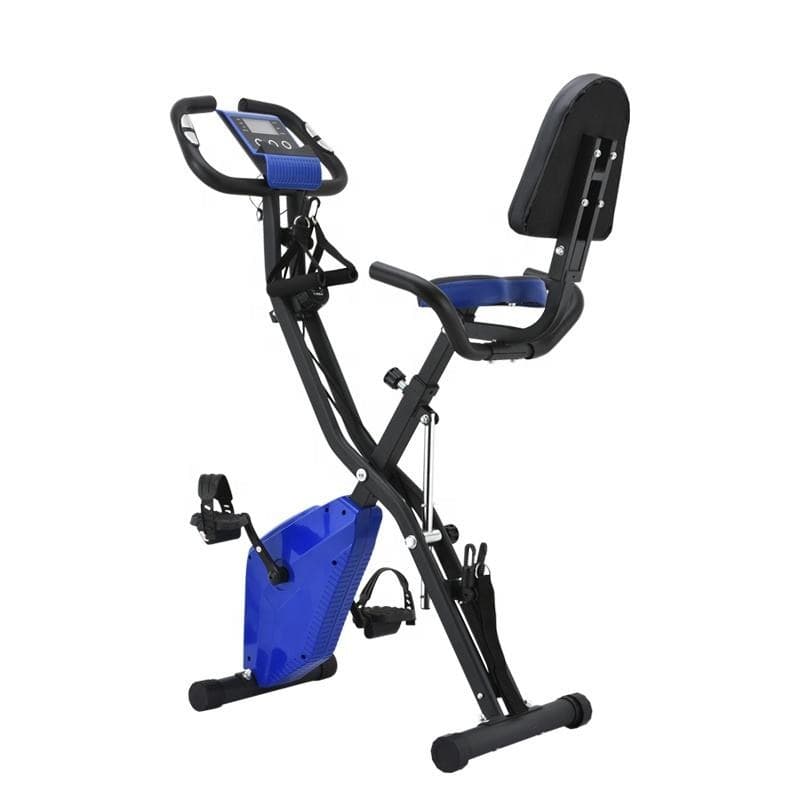
The FoldFit X1
Folds flat, £179.99 including VAT, the bike this page's low-impact case is built around.
See the FoldFit X1Key takeaways
- 1A treadmill burns a little more, 288 calories per 30 minutes running against 252 cycling[2], and it is weight-bearing, which the NHS names as important for bone density[1].
- 2An exercise bike does neither of those things, and in exchange it is low-impact and far kinder to your knees, hips and back.
- 3Buy the treadmill for bone strength, running training or the higher calorie ceiling, if your joints are fine.
- 4Buy the bike for sore joints, a small room, a quiet shared home, or riding while you watch something.
- 5Cycling does not build bone density. The NHS states plainly that cycling is not weight-bearing exercise[1].
Exercise bike vs treadmill: the short comparison
A treadmill wins on calories and on bone loading. A bike wins on joints, space, noise and price. Everything below is the detail behind those two sentences.
| What you are comparing | Exercise bike | Treadmill |
|---|---|---|
| Calories in 30 minutes | 252, cycling at a moderate pace[2] | 288 running at 5 mph, 175 walking at 4 mph[2] |
| Impact on your joints | Low. You are seated and the frame carries your weight | High. Your full body weight lands through the leg on every stride |
| Bone loading | None. The NHS says cycling is not weight-bearing exercise[1] | Weight-bearing, the kind the NHS names for bone density[1] |
| Space at home | Roughly the footprint of a chair, and some models fold flat | A long running deck, plus clear space behind it |
| Noise | Quiet. No motor, and magnetic resistance makes no contact | A motor plus footfall, which carries through floors and walls |
| Price | £59.99 to £549.00 including VAT across our range | We do not sell treadmills, so we do not quote a price for one |
When you should buy the treadmill, not the bike
Buy the treadmill if your bones are the reason you are exercising, if you are training to run, or if you want the higher calorie ceiling and your joints are fine. We sell exercise bikes and no treadmills, so this is the part of the page that costs us money, and it is the part we are most sure about.
- Bone strength is your goal. The NHS is explicit that weight-bearing and resistance exercise are the kinds that matter for bone density, and equally explicit that cycling is not weight-bearing. A bike will not do this job, and no feature on any bike changes that.
- You are training to run. Nothing on a bike rehearses the movement of running. If you have a 10k or a marathon in the diary, you need to be on your feet.
- You want the higher ceiling and your knees, hips and back are fine. Running edges cycling on calories per half hour, and if nothing hurts, that is a real advantage you may as well have.
- You want to walk indoors in winter. Walking on a treadmill still loads the skeleton, even at a gentle pace, which a bike never does at any resistance level.
If two or more of those describe you, stop reading a bike shop's guide and go and buy a treadmill. We would rather send you to the right machine than sell you the wrong one.
When the exercise bike is the right buy
The bike wins when the treadmill's strengths are not what you need, or when its impact is exactly the thing you are trying to avoid.
- Your knees, hips or back complain. You sit down and the frame takes your body weight, so there is no pounding to absorb. This is the single most common reason people move from a treadmill to a bike.
- You live in a flat, or somebody sleeps nearby. There is no motor and no footfall, so a magnetic bike is quiet enough to ride while the house is asleep.
- The room is small. A bike takes roughly the space of a chair, and a folding model goes in a cupboard between rides.
- You want to watch something while you train. Sitting upright and steady makes a screen easy to follow, which is harder at a run.
If the room is the reason you are choosing at all, our FoldFit X1, which folds flat is £179.99 including VAT with free UK delivery, and it packs away between rides in a way no treadmill does. For steady upright cardio closer to the treadmill session most people picture, there are upright studio bikes, or, if getting on and off matters, low-impact recumbent bikes that you step through rather than climb onto.
Is 30 minutes of stationary bike the same as 30 minutes of walking?
No, and cycling comes out ahead on calories. Harvard Health puts moderate stationary cycling at 252 calories per 30 minutes for a 155-pound person, against 175 for walking at 4 mph[2]. Half an hour of pedalling burns roughly what forty minutes of brisk walking would.
Walking still does one thing cycling cannot. It carries your body weight, and that is the weight-bearing loading the NHS singles out for bone density. So the two are not interchangeable: cycling gives you more calories per minute, walking gives you the bone loading. If you want structure for the riding half, our beginner bike sessions set out what a week actually looks like.
Which is better for weight loss, an exercise bike or a treadmill?
A treadmill has the higher ceiling if you run on it, at 288 calories per half hour against 252 for moderate cycling, but the gap is smaller than most people expect and it closes completely if you would only ever walk. The machine you use four times a week beats the machine that burns more on paper.
Weight loss is its own subject and we have not tried to squeeze it in here. Our guide on can a bike help you lose weight covers the calories, the timescales and the belly-fat question properly.
Does an exercise bike build bone density?
No. The NHS states that swimming and cycling are not weight-bearing exercise[1], and that weight-bearing exercise and resistance exercise are particularly important for improving bone density[1]. Those two lines sit on the same NHS page, and together they are the clearest statement of the real difference between these two machines.
We are not going to soften that. If a doctor has told you to work on your bone strength, a bike is not the machine for it, whatever the resistance level says. Plenty of retailers will imply otherwise. The honest answer is that a bike does a great deal, and this is one of the things it does not do.
Is a treadmill or an exercise bike better for bad knees?
A bike is the lower-impact machine. You are seated, and your body weight goes through the frame instead of landing through the knee on every stride. That is a description of how the two machines work, not advice about your knee.
We are not clinicians. If you have knee pain or an injury the right first step is a GP or a physiotherapist, not a product page. For what NICE and the NHS actually say about cycling with sore joints, and when a bike is the wrong idea, we wrote a separate guide on knee-friendly bikes.
Exercise bike vs treadmill, questions answered
Is 30 minutes of stationary bike the same as 30 minutes of walking?
Which is better for weight loss, an exercise bike or a treadmill?
Is it better to walk on a treadmill or use an exercise bike?
Does an exercise bike build bone density?
Is a treadmill or an exercise bike better for bad knees?
Which takes up less space, an exercise bike or a treadmill?
Sources
- NHS: Osteoporosis, prevention
- Harvard Health Publishing: Calories burned in 30 minutes for people of three different weights (last updated 8 March 2021)
The calorie figures are for a 155-pound (about 70 kg) person over 30 minutes. Heavier people burn more and lighter people burn less, so treat them as a comparison between the two machines rather than a target for your own session. This guide describes what the NHS says. It is not medical advice: for advice about your own health, see a GP.