Exercise bike vs cross trainer: which should you buy?
Here is the uncomfortable truth for a bike shop: on paper, the cross trainer does more. It burns more, 324 calories per 30 minutes for a general elliptical session against 252 for moderate cycling[2]. It keeps you on your feet, and the Royal Osteoporosis Society says that being on your feet and adding an extra force through your bones helps to maintain or improve your bone strength[1], which a seated bike cannot offer. It works your arms as well as your legs, and it does all of that while staying low-impact. So why would anyone buy the bike? Space, price, simplicity and pure knee-gentleness, and for plenty of people those four decide it. This guide splits the two honestly, because pretending the elliptical does less would be the fastest way to lose your trust.
Written by the Exercise Bike team. We sell exercise bikes and no cross trainers, and on paper the cross trainer does more, so we have said so plainly. Updated 19 July 2026.
Contents
Key facts
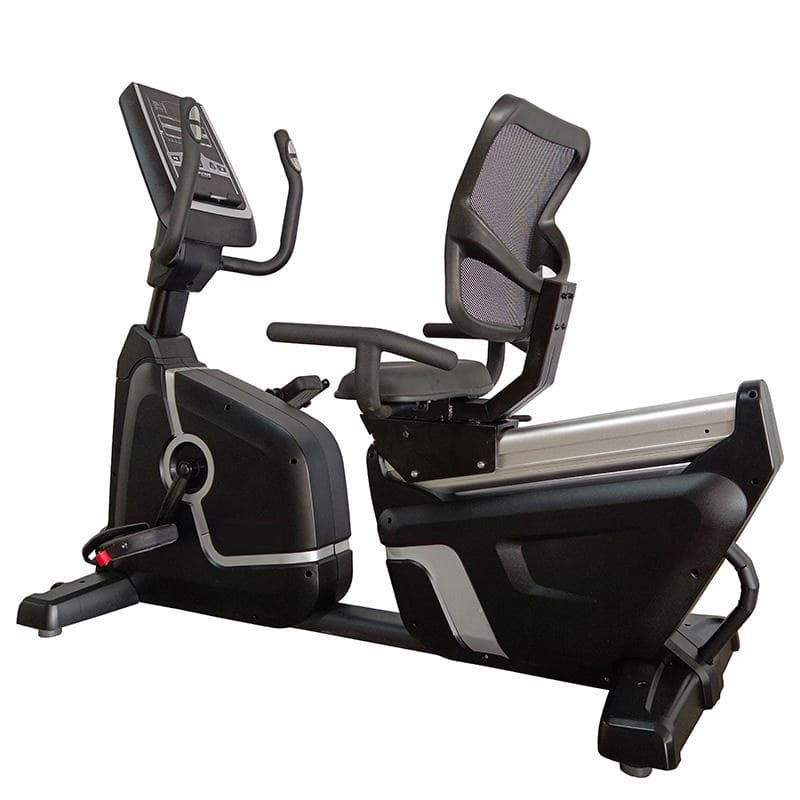
ComfortGlide R500
Our recumbent, £549.00 including VAT. Step through the frame and sit back against a full backrest.
See the ComfortGlide R500Key takeaways
- 1On paper the cross trainer does more: 324 calories per 30 minutes against 252 for cycling[2], plus bone loading and worked arms.
- 2The Royal Osteoporosis Society says being on your feet and adding force through your bones helps bone strength[1]. Seated cycling gives your bones none of that.
- 3The bike wins on the practical rows: space, price, simplicity and knee-gentleness.
- 4Buy the cross trainer for the bigger burn, bone loading and upper-body work, if you have the room.
- 5Buy the bike if a big standing machine will not fit your room or your knees.
Exercise bike vs cross trainer: the short comparison
The cross trainer wins on calories, bone loading and upper body. The bike wins on space, price, simplicity and knee-gentleness. The table is the whole argument in one place, and the sections after it take each row in turn.
| What you are comparing | Exercise bike | Cross trainer |
|---|---|---|
| Calories in 30 minutes | 252, cycling at a moderate pace[2] | 324 for a general elliptical session[2] |
| Bone loading | None. You sit, so the frame carries your weight, not your bones | You are on your feet, the loading ROS links to bone strength[1] |
| Muscles worked | Mainly lower body: legs and glutes | Legs plus arms, through the swinging poles |
| Impact on your joints | Low, seated and stable in one fixed position | Low too: your feet glide on the pedals and never strike the ground |
| Floor space | Roughly a chair's footprint, and some models fold flat | Big in every direction: stride path, poles and standing height |
| Price | £59.99 to £549.00 including VAT across our range | Generally more than a comparable bike. We do not sell them, so we quote no price |
Is a cross trainer the same as an elliptical?
Yes, one machine, two names. UK shops and gyms usually say cross trainer, American sites say elliptical, and search results mix the two freely. You stand on two large pedals that glide in an oval path, and you hold a pair of poles that swing in time with your stride, so your arms push and pull while your legs drive.
That standing, whole-body glide is the machine's identity, and it explains everything else on this page: the higher burn, the bone loading, the worked arms, and also the size of the thing.
Which burns more calories, an exercise bike or a cross trainer?
The cross trainer, and the gap is not small. Harvard Health puts a general elliptical session at 324 calories per 30 minutes for a 155-pound person, against 252 for moderate stationary cycling[2]. That is over a quarter more energy for the same half hour, because standing and driving four limbs costs more than seated pedalling.
We sell the machine that burns less, and we are telling you anyway, because you would find out in one search and remember that we fudged it. If burning the most per session is your single deciding factor and the other rows in the table do not put you off, the cross trainer is your machine. For how calories actually turn into results, our guide to exercise bikes and weight loss covers it without the miracle claims.
Does a cross trainer do more for your bones than a bike?
Yes. A cross trainer keeps you on your feet, with your skeleton carrying your body weight through every stride. The Royal Osteoporosis Society, the UK's national bone-health charity, says that when you are on your feet and you add an extra force through your bones, this helps to maintain or improve your bone strength[1]. A bike gives your bones none of that, because you sit down and the frame does the carrying.
Worth being precise about one thing: ROS is describing impact exercise, and a cross trainer glides rather than strikes, so it is a gentler dose of on-your-feet loading than running or skipping. But seated cycling is not weight-bearing at all, so on bones the comparison is not close. If bone strength is one of your reasons for exercising, that is a genuine argument for the cross trainer, and we would rather hand you that argument than hide it.
When you should buy the cross trainer, not the bike
This is the page in our comparison series where honesty costs us the most, because the cross trainer's on-paper case is the strongest. Buy it if the list below is what you are after.
- You want the bigger burn. At 324 calories per half hour against the bike's 252, the cross trainer has a clear lead, and it holds that lead session after session.
- Bone loading matters to you. It keeps you upright on your feet, the kind of loading ROS links to maintaining and improving bone strength, and a seated bike simply cannot do that.
- You want your arms working, not resting. The poles put your upper body into every minute, where a bike leaves it riding along.
- You want all of that while staying low-impact. Your feet glide and never strike, so it is far gentler than running for a similar effort.
If most of that list is you, and you have the room and the budget for a big standing machine, stop reading a bike shop's guide and go and buy a cross trainer. We mean it.
When the exercise bike is the right buy
So why does anyone buy the bike? Because the cross trainer's wins all happen on paper, and homes are not made of paper. The bike takes the four practical rows: space, price, simplicity and knee-gentleness.
- Space. A cross trainer is big in every direction and hard to store. A bike takes roughly the footprint of a chair, and a folding model packs away between rides.
- Price. A cross trainer generally costs more than a comparable bike. Our bikes run from £59.99 to £549.00 including VAT, with free UK delivery on every one.
- Simplicity. On a bike you sit down and pedal. There is no standing glide to coordinate, no poles, nothing to learn, which is exactly why bike sessions tend to survive busy weeks.
- Knee-gentleness and stability. For someone protecting a specific knee, seated and stable beats standing and moving. You cannot fall off a recumbent you are sitting inside.
If that describes your home and your knees, the seated end of our range is where to look. Our recumbent ComfortGlide R500 is £549.00 including VAT: you step through the frame and sit back against a full backrest, which is as stable as home cardio gets. There are more recumbent bikes with back support on their own page, and if you are a bigger rider our high weight-capacity bikes are built for exactly that.
Is an exercise bike or a cross trainer better for bad knees?
Both are low-impact, so the honest difference is stability and simplicity. On a bike you sit, the frame carries your weight, and the movement is a fixed circle. On a cross trainer you stand and balance through a long gliding stride, which asks more of the leg on every rep. For a specific knee problem, the seated bike is the simpler, more stable machine.
We are not clinicians. If you have knee pain or a diagnosed condition, talk to a GP or a physiotherapist before buying anything. For what NICE and the NHS actually say about cycling with knee pain, we wrote a separate guide on exercise bikes for bad knees.
Exercise bike vs cross trainer, questions answered
Is a cross trainer the same as an elliptical?
Which burns more calories, an exercise bike or a cross trainer?
Is a cross trainer weight-bearing?
Is an exercise bike or a cross trainer better for bad knees?
Which takes up more space, a cross trainer or an exercise bike?
Is a cross trainer or an exercise bike better for weight loss?
Sources
- Royal Osteoporosis Society: Exercise for bones (reviewed 1 June 2026)
- Harvard Health Publishing: Calories burned in 30 minutes for people of three different weights (last updated 8 March 2021)
The calorie figures are for a 155-pound (about 70 kg) person over 30 minutes. Heavier people burn more and lighter people burn less, so treat them as a comparison between the two machines rather than a target for your own session. This guide describes what the Royal Osteoporosis Society says. It is not medical advice: for advice about your own bones, joints or knees, see a GP.